Time-to-power is the race. Waiting on answers is the drag.
Hyperscale, colocation or enterprise, the pattern is the same. Schedules rarely stall on concrete. They stall on decisions: submittals, change assessments and RFIs waiting on information held in different systems. With Criad the answer and its evidence are in the meeting. Meetings with decisions, not a plan for more meetings.
Where the time goes
Every day a hall waits to energise is a day of lost revenue. Most of those days are not spent building. They are spent waiting: a submittal sits, a change assessment goes round several companies, an RFI makes its round trip. You pay for the wait on every site, and the same questions come back on the next one.
- 1submittal sits
- 2change assessment
- 3RFI round-trip
answers come with evidence; decided in the meeting
The cost of waiting
$8-40Mper day · per gigawatt
Lost revenue for every day a gigawatt of capacity waits to energise.
Low end: colocation-rate delay estimates (Exto, 2026) · top: AI capacity pricing, ~$15M per MW-year (2025 analyses)
Planned 2026 capital spend by the four largest cloud builders, most of it AI data centres. Up 77% on 2025.
Source: company Q2 2026 earnings guidance.
Four issues, in your words.
The progress report says on track. Nobody can show which elements that is based on.
We asked for a change to the cooling units on one page. The knock-ons arrived later, as claims.
Every campus repeats the last one, and every project team checks it again by hand.
Handover is a pile of files. Operations starts by rebuilding the record.
Your standards, checked on every design issue
We have a design standard. Finding out whether this project follows it takes a review team and a month.
Early design runs several options in parallel, and a technology change can land mid-design. Load your standard, your basis of design or an open specification beside the project documents. Criad checks each option and each design issue against it, element by element, and lists the departures with the clause and the measurement, so your reviewers spend their time on the judgement calls.
Open this use caseOwner standard against product data · rack envelope
Envelope clause
Racks shall fit the envelope
0.60 × 1.20 × 2.00 m (W × D × H)
at every position shown on the layout.
42 of 118
Ranked by authority
Positions checked on the model
240 of 240 fail on height
Public specification, rev 1.1
Width 600 mm · depth 1,068 mm
Height 2,286 mm
Load rating 1,400 kg
3 of 12
Densify within the footprint
We have to double the capacity of this site in the same footprint, without doubling the capex.
Higher-density racks and a move from air to hybrid or liquid cooling change three things at once: the load on the slab, the clearances around every unit and the draw on every feed. Criad checks a proposed option against the model and the governing documents, hall by hall, so the feasibility answer comes with its evidence and the structural questions are named before the design moves.
Open this use caseProgress you can audit
The monthly report says the hall is on track. Nobody can show which elements that is based on.
Install status per element rolls up from the model, not from retyped returns. The same check renders as exec tiles, a spreadsheet, a sentence or a 3D view, and every number is cited.
Open this use caseThe same check as exec tiles, every number cited.
The same rows, straight into the spreadsheet teams already use.
"Which Hall 2 cabinets are installed?"
source: Progress layer · package A4401
The same answer as a sentence, citation included.
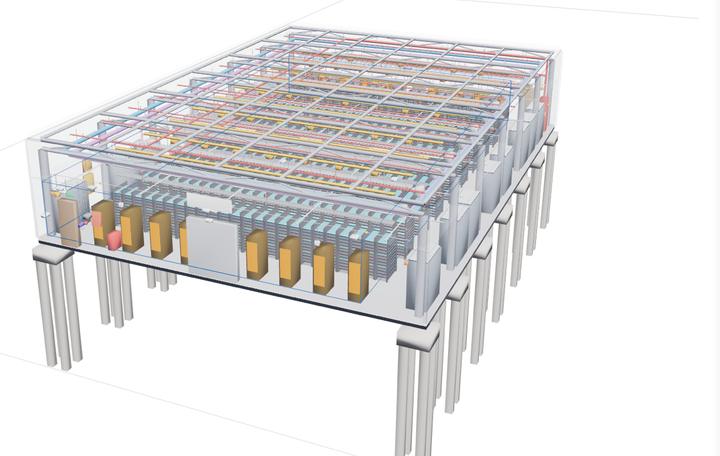
The same 16 cabinets, isolated on the real model in the product.
Check once, repeat on every site
Every campus repeats the last one. Every project team still checks it again by hand.
Your campuses repeat: your project knowledge should too. Every element is linked to its drawing, spec, order and status, so a check written on one site re-runs on the next.
Open this use caseSITE 1 · STRUCTURED
- 1Ingest as issued: model, 152 sheets, specs
- 2Link: element → drawing · spec · order · status
- 3Verify: by authority, measured on geometry
One campus, fully structured
SITE 2
same checks · re-run ✓
SITE 3
same checks · re-run ✓
SITE N
same checks · re-run ✓
Knowledge compounds across the fleet
OPERATIONS · FROM DAY ONE
> which rack is this?
✓ schedule row, spec, approvals attached
> what serves it?
✓ rack ← distribution frame ← fibre entry
> still under warranty?
✓ O&M row and warranty on record
The record stays live and queryable for decades
example queries from a structured reference campus
Approve a change with every knock-on in view
We asked for a change to the cooling units on one page. The knock-ons arrived later, as claims.
One change is never one change. Before you approve it, see what it touches: the product order, the governing drawing, the install plan. The evidence is in front of the person who decides.
Commissioning readiness
Commissioning slipped by weeks. A clearance nobody spotted, a section left out, a permit that took a fortnight.
Commissioning is where every unresolved question surfaces at once. Criad keeps each system's install status, its outstanding clearances and the access it needs in one record, so the commissioning team can see what is ready, what is blocked and what each block is waiting on, before the commissioners are booked.
Open this use caseA handover record that operates
Handover is a pile of files. Operations starts by rebuilding the record.
The handover is the links, kept alive. Each element keeps its O&M row, its warranty and its power and fibre paths, so the record stays live and queryable for decades.
Open this use case42U RACK · DATA HALL
- 0.60 × 1.20 × 2.00 m
- 240 per hall
- 1 of 1,440 on campus
- measured in
3D MODEL
Real geometry, shared origin: sizes and
clearances are measured, never guessed
- drawn on
GOVERNING DRAWING
telecom layout · rev 1 · issued 17 Jul 2026
a new revision updates every element on it
- limited by
SPEC CLAUSE
envelope max 0.60 × 1.20 × 2.00 m · telecom spec
✓ checked automatically, every revision
- ordered as
PRODUCT & ORDER
one approved product · 1,440 units
approve once, the whole order updates
- built under
PROGRESS
status per rack · phase-aware, both phases
reports roll up live, nothing retyped
- operated as
OPERATIONS
O&M row · warranty · fibre & power paths
the handover is these links, kept alive
real values from a structured reference campus
Judge it on a real job.
Book a call. Bring a real question from a job you know, and see how the answer and its evidence come together.
Your project, as it is. Drawings, specs, model and programme come in without retyping.
Your questions, with evidence. Every answer cites the sheet, the clause or the measurement.
Your people decide. Every decision keeps its evidence for later review.
Stop waiting. Start building.
Book a call with the founders. Thirty minutes, your questions, and what Criad looks like on a data centre build.